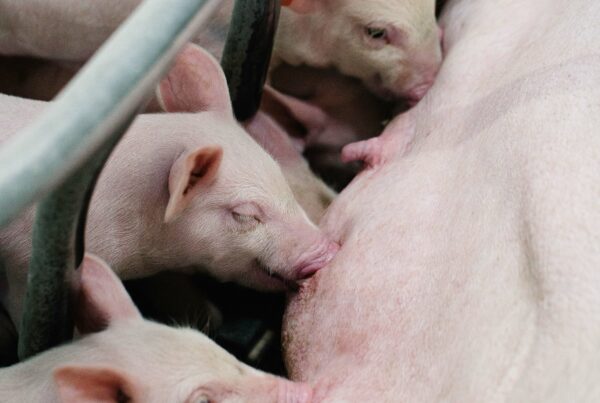

Between environmental transition, societal expectations, and technical innovations, the swine sector is exploring new balances.
Researchers, farmers, experts, and citizens share the same observation: to remain sustainable, pig production must rethink the way it produces, valorizes, and engages in dialogue.
Researchers’ perspective: when welfare and sustainability become one
Research confirms it: animal welfare is no longer optional, but a condition for sustainable development.
In their study published in Sustainability in 2025, the research team provides a clear assessment: pig farming must evolve toward practices that combine efficiency, respect for the animal, and environmental performance.
The researchers emphasize the importance of incorporating pigs’ natural behaviors into farming systems. Simply put, the more a pig can express its behaviors (rooting, exploring, interacting), the healthier and more productive it is.
The study also highlights the growing role of digital monitoring tools (sensors, AI, video) to measure and anticipate welfare indicators.
Welfare is not an additional constraint: it is a lever for balancing performance and social acceptability.
Farmers’ perspective: between adaptation and innovation
In the field, farmers are at the forefront of this transformation.
Facing rising costs, regulatory complexity, and evolving societal expectations, many are testing new approaches inspired by the circular bioeconomy.
Manure valorization into biogas, nutrient recovery from effluents, incorporation of by-products (algae, brewers’ grains, bread, rapeseed meal) into feed… these are all practices derived from research and now being experimented with on farms.
They help reduce dependence on imported soy, limit emissions, and diversify income streams.
These initiatives require investment and technical support, but they reflect a profound shift: producing better, using less, and giving value back to what was once considered waste.
Technical experts’ perspective: measure, compare, progress
For industry advisors and environmental engineers, sustainability relies on measurement and transparency.
The study highlights a central tool: Life Cycle Assessment (LCA).
This method evaluates the environmental impacts of pig production across the entire chain: feed, housing, energy, and effluents.
The findings are clear:
- Feed represents the largest source of emissions.
- Manure management directly influences eutrophication and acidification.
- The approach must remain holistic, as addressing a single lever in isolation can shift impacts rather than reduce them.
For experts, LCA becomes a management tool, allowing actions to be prioritized and progress to be objectively tracked.
You can only improve what you measure: this applies both to the environment and to welfare.
Society’s perspective: A demand for meaning and transparency
The study reminds us that citizens’ views play a decisive role in the sector’s transformation.
For the majority of Europeans, animal welfare and environmental sustainability are now integral to product quality.
This growing expectation creates both pressure and opportunity: the chance to strengthen dialogue between producers and consumers.
However, the researchers also highlight a paradox: while the public supports animal-friendly products, it still knows little about actual farming practices. Better information also restores legitimacy to a profession often misunderstood.
What they all share
Despite different perspectives, researchers, field actors, and citizens converge on a common goal: reconciling production, ethics, and the environment.
- Animal welfare becomes a key indicator of sustainability.
- Circular bioeconomy paves the way for full resource valorization.
- Measurement tools (LCA, sensors, AI) bring rigor and transparency.
- Sustainability emerges as a collective endeavor, at the intersection of science, technology, and society.
And tomorrow?
The authors call for continued research and interdisciplinary cooperation: nutrition, environment, animal behavior, and rural economics.
Three priorities are emerging:
- Optimize food by-products to ensure their availability and nutritional value.
- Improve manure treatment technologies to maximize energy and nutrient recovery.
- Integrate social dimensions into sustainability assessments to better represent farm realities.
Tomorrow’s pig production will not only be greener or more ethical: it will be smarter, circular, and resilient.
Source: Sossidou E. N., Banias G. F., Batsioula M., Termatzidou S.-A., Simitzis P., Patsios S. I., Broom D. M.
Modern Pig Production: Aspects of Animal Welfare, Sustainability and Circular Bioeconomy, Sustainability, 2025.